
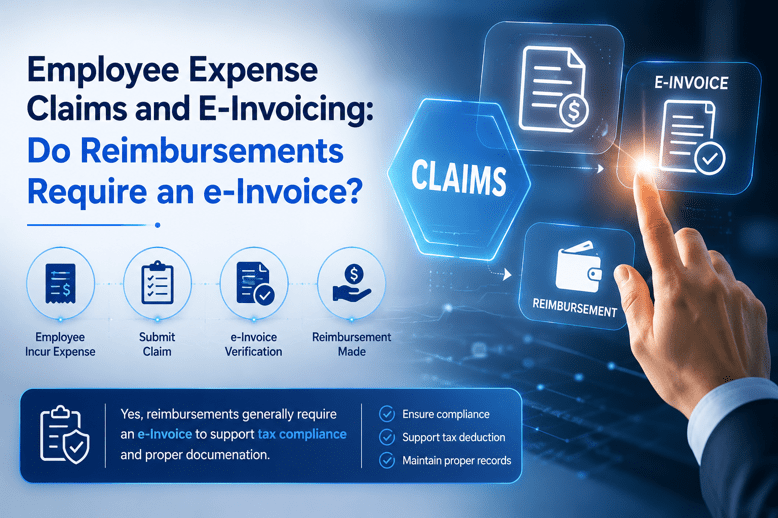
As businesses prepare for e-Invoicing compliance, one area that frequently causes confusion is employee expense claims. Many employers are unsure whether reimbursements made to employees require an e-Invoice or a self-billed e-Invoice.
The good news is that in most cases, the answer is no.
Understanding Employee Expense Claims
Employee expense claims occur when an employee pays for a business-related expense using their own money and subsequently seeks reimbursement from the employer.
Common examples include:
- Parking charges
- Toll expenses
- Petrol for business travel
- Accommodation during business trips
- Meals incurred during official duties
- Office supplies purchased on behalf of the company
The key question is whether the employee is supplying goods or services to the employer. If not, there is generally no e-Invoice obligation.
When No e-Invoice Is Required
A genuine reimbursement of business expenses does not create a transaction between the employee and employer. Since the employee is not selling anything to the company, no e-Invoice or self-billed e-Invoice is generally required.
Key Takeaway
Before considering any e-Invoice obligations, ask this simple question:
“Is the employee selling goods or serviceWhen an employee incurs expenses solely in the course of employment and is later reimbursed by the employer, the reimbursement does not constitute a sale or business transaction.
As a result:
- The employee is not required to issue an e-Invoice to the employer.
- The employer is not required to issue a self-billed e-Invoice to the employee.
- The reimbursement should simply be supported by appropriate documentation such as receipts, invoices, claim forms, and approval records.
Example
An employee attends a client meeting and incurs the following expenses:
- Parking: RM10
- Toll: RM8
- Petrol: RM60
The employee submits the receipts and claims RM78 from the company.
In this situation:
✓ No e-Invoice is required from the employee.
✓ No self-billed e-Invoice is required by the employer.
✓ The reimbursement can be processed based on the supporting documents provided.
What If the Receipt Is Issued in the Company’s Name?
Where possible, businesses should request suppliers to issue invoices or receipts directly in the company’s name.
This provides clearer support for:
- Tax deductions
- SST compliance
- E-Invoicing records
- Internal audit documentation
The employee is merely acting as the payer and not the supplier of goods or services.
Common Misconception
A common misunderstanding is that every payment made to an employee requires a self-billed e-Invoice.
This is incorrect.
s to the company?”
If the answer is no and the payment is merely a reimbursement of business expenses incurred during employment, no e-Invoice or self-billed e-Invoice is typically required.
Businesses should instead ensure that adequate supporting documents are maintained to substantiate the expense claim.
Leave a Reply