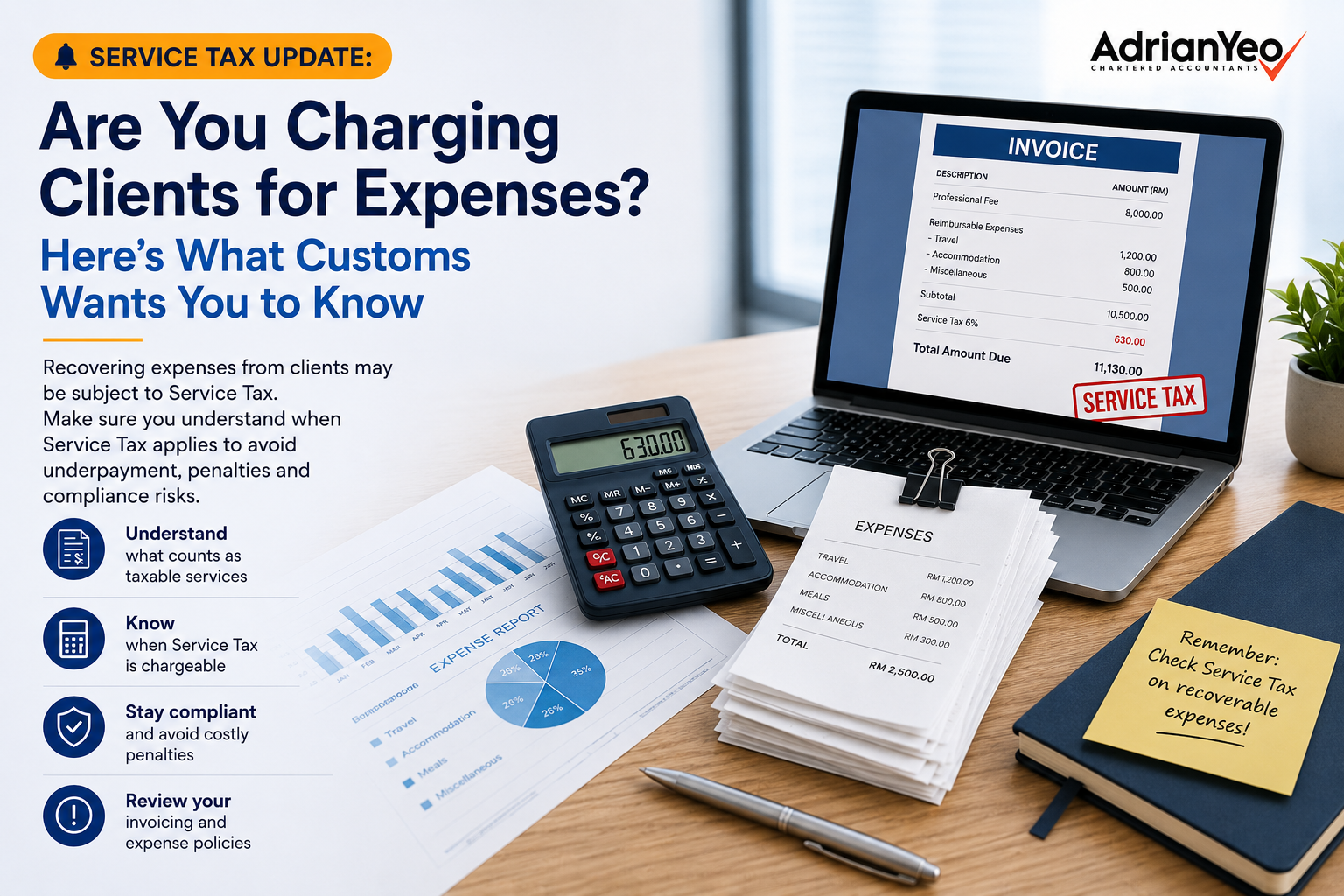

Many businesses incur expenses on behalf of their clients and later recover those costs through an invoice. These may include government filing fees, stamp duty, courier charges, travelling expenses or third-party service fees.
A common assumption is that because these are merely “recovered costs”, they are automatically excluded from Service Tax.
Unfortunately, that isn’t always the case.
According to the Royal Malaysian Customs Department (RMCD)’s Guide on Disbursement and Reimbursement, the Service Tax treatment depends on whether the expense is a disbursement or a reimbursement—not simply what you call it on the invoice.
What Is a Disbursement?
A disbursement occurs when a business pays an expense as an agent on behalf of its client.
In this situation, the liability belongs to the client, while the business merely facilitates the payment.
Examples may include:
- Government filing fees
- Stamp duty
- Official license or registration fees paid on behalf of a client
Provided the required conditions are satisfied, these amounts are generally not regarded as consideration for the taxable service, and therefore are not subject to Service Tax.
What Is a Reimbursement?
A reimbursement is different.
These are expenses incurred by the business in the course of providing its own services, before recovering the costs from the client.
Examples include:
- Courier charges
- Travelling expenses
- Accommodation
- Printing and photocopying
- Administrative expenses
Since these expenses are incurred in providing the taxable service, recovering them from the client generally forms part of the consideration for the service and may therefore be subject to Service Tax.
Why This Difference Matters
Consider the following example.
A consulting firm issues an invoice comprising:
- Professional Fee – RM5,000
- Government Filing Fee – RM300
- Courier Charges – RM50
Although all three amounts appear on the same invoice, they do not necessarily receive the same Service Tax treatment.
The government filing fee may qualify as a disbursement if all the required conditions are met.
However, the courier charges are generally regarded as a reimbursement because they are incurred while delivering the consulting service.
Understanding the nature of each expense is therefore more important than simply grouping all charges together.
It’s Not Just About the Invoice
Many businesses believe that separating expenses into different invoice lines automatically excludes them from Service Tax.
That is not the intention of the Customs Guide.
Customs will consider the actual facts of the transaction, including:
- Who was legally responsible for the expense?
- Who received the goods or services?
- Was the business acting as an agent for the client?
- Is there supporting documentation?
- Does the expense satisfy the conditions for a disbursement?
Simply renaming an expense as a “disbursement” will not change its tax treatment.
What Businesses Should Do
To minimise Service Tax risks, businesses should:
- Understand whether each recovered expense is a disbursement or reimbursement.
- Review engagement terms to determine whether expenses are incurred on behalf of clients.
- Keep supporting documents for all recovered expenses.
- Clearly describe each item in the invoice.
- Review billing practices to ensure they comply with the latest Customs guidance.
Final Thoughts
Recovering expenses from clients is common across many industries, but not every recovered cost receives the same Service Tax treatment.
The key question is not “How should I format my invoice?” but rather “What is the true nature of this expense?”
By correctly distinguishing between disbursements and reimbursements, businesses can reduce compliance risks, avoid unnecessary Service Tax exposure and prepare for future Customs audits with greater confidence.
If your business regularly recovers expenses from clients, now is a good time to review your invoicing practices and ensure they align with the latest RMCD guidance.
Need help reviewing your invoice format or understanding the latest Service Tax updates?
Our team at AdrianYeo is here to help businesses stay compliant while reducing unnecessary tax exposure. Contact us today for professional guidance.