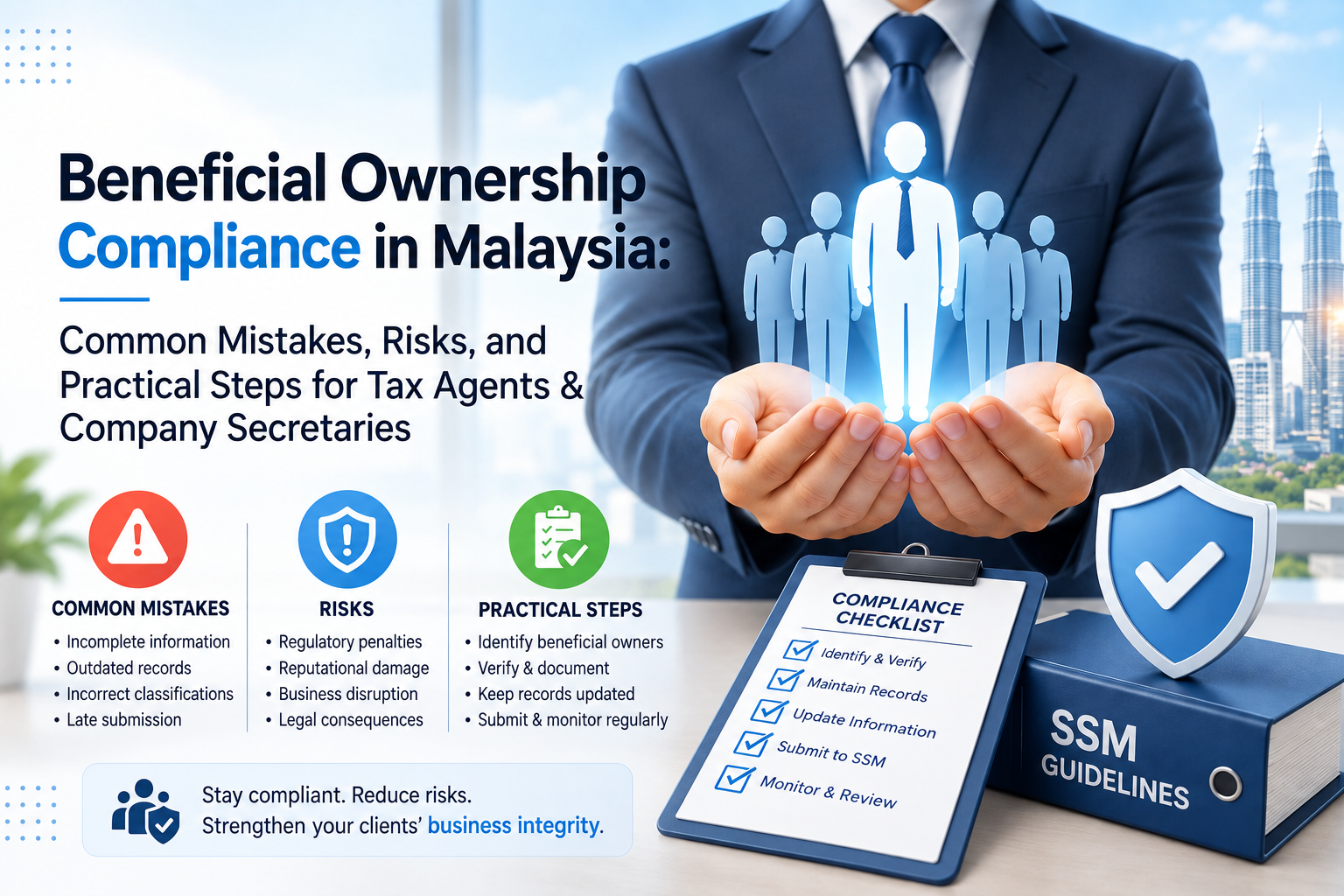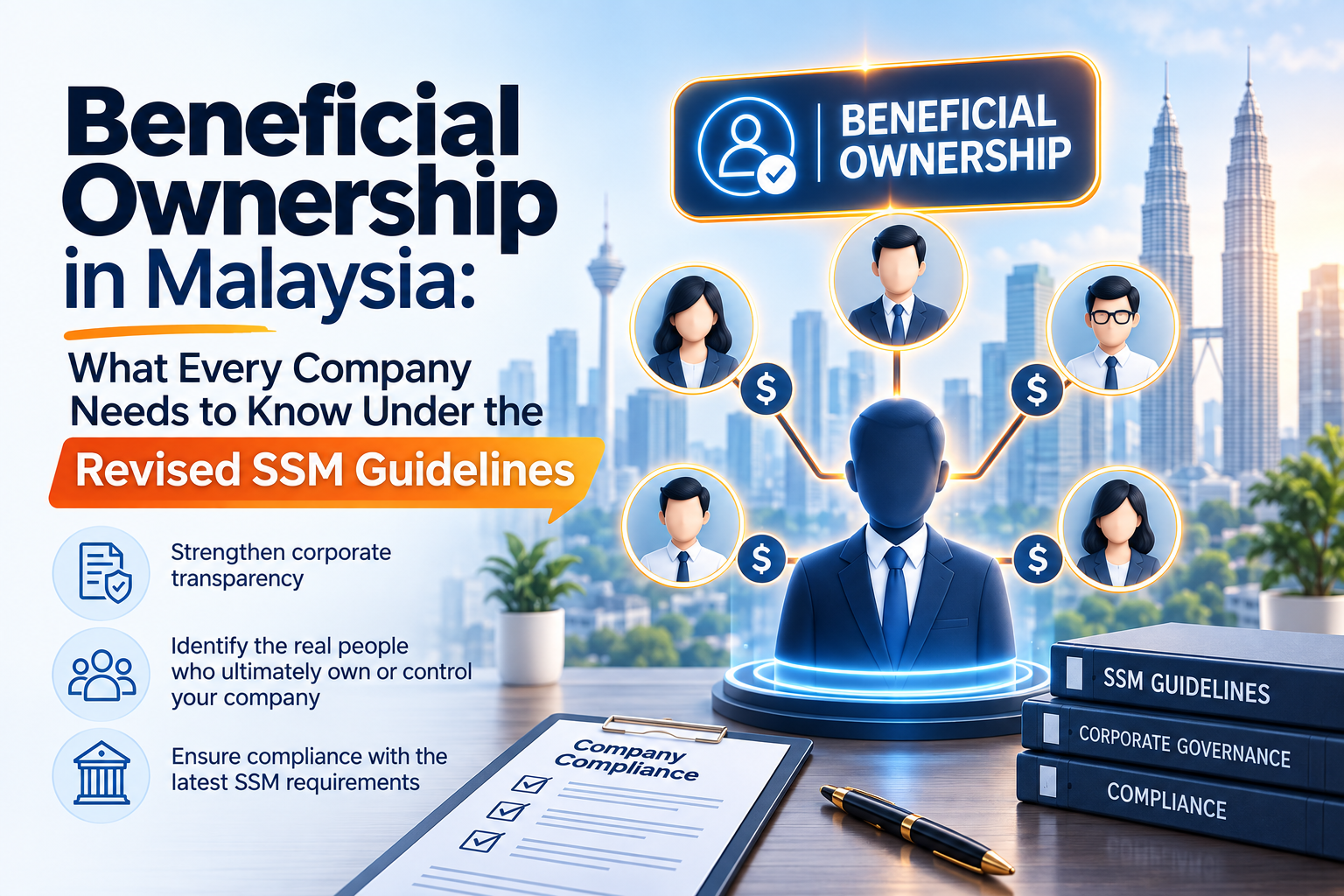
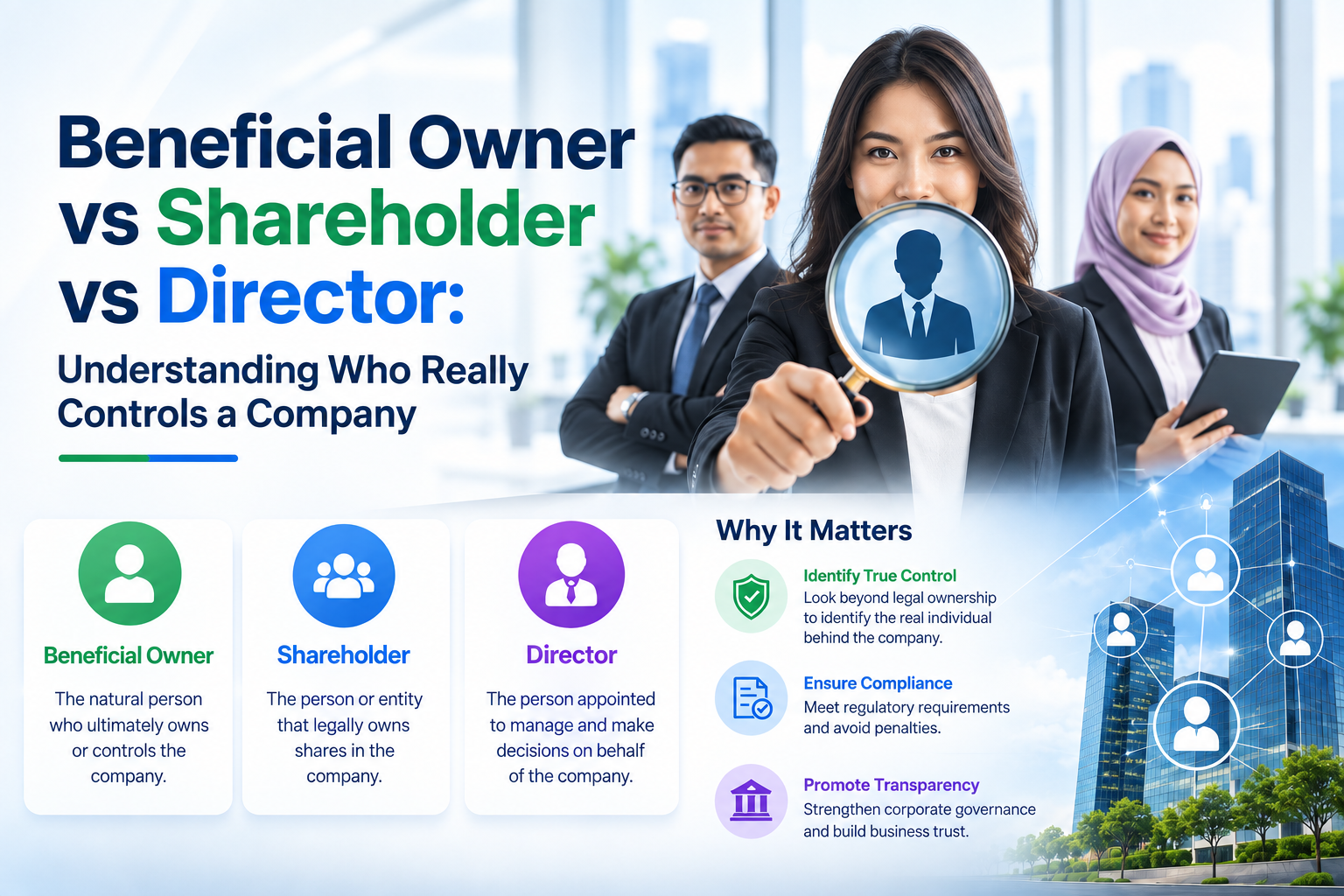

When discussing company ownership, many people use the terms Beneficial Owner (BO), Shareholder, and Director interchangeably.
However, these three roles are not always the same.
A shareholder may own shares but may not be the person who ultimately controls the company. A director may manage the company but may not have any ownership interest. Meanwhile, a Beneficial Owner is the individual who ultimately owns or exercises effective control over the company.
Understanding the difference is essential, especially following the revised SSM Beneficial Ownership Guidelines 2025, which emphasise identifying the real individuals behind company ownership and control.
In this article, we explain the differences between BO, shareholders, and directors, together with practical examples based on situations highlighted in the revised guideline.
Beneficial Owner vs Shareholder vs Director: What Is the Difference?
|
Role |
Meaning |
Main Responsibility |
| Shareholder | A person or entity registered as owning shares in a company | Provides capital and holds ownership interest |
| Director | A person appointed to manage and oversee the company | Makes management and strategic decisions |
| Beneficial Owner | The natural person who ultimately owns or controls the company | Represents the true individual behind ownership or control |
1. Shareholder: The Legal Owner of Shares
A shareholder is the person or company whose name appears in the company’s register of members.
Shareholders may have rights such as:
- receiving dividends;
- voting at general meetings;
- appointing directors; and
- participating in major company decisions.
However, being a shareholder does not always mean being the Beneficial Owner.
For example:
Company A has the following structure:
- Mr Lim owns 100% of Company B.
- Company B owns 100% of Company A.
Although Company B appears as the shareholder of Company A, the ultimate Beneficial Owner of Company A is Mr Lim because he ultimately controls Company B.
2. Director: The Person Managing the Company
A director is responsible for managing the company’s affairs and making business decisions.
However, a director is not automatically a Beneficial Owner.
Example:
ABC Sdn Bhd has:
- Mr Tan – Managing Director
- Ms Lee – Shareholder owning 100% of shares
Mr Tan manages daily operations but does not own shares or exercise ultimate control.
In this situation:
- Mr Tan = Director
- Ms Lee = Shareholder and Beneficial Owner
This shows that management control and ownership control are not always the same.
3. Beneficial Owner: The Person Behind the Ownership or Control
A Beneficial Owner must be a natural person who ultimately owns or controls the company.
A person may qualify as a BO through:
Direct ownership
Example:
Mr Ahmad owns 80% of XYZ Sdn Bhd.
Mr Ahmad is the Beneficial Owner.
Indirect ownership
Example:
Mr Wong owns 100% of Holding Company Sdn Bhd.
Holding Company Sdn Bhd owns 60% of Trading Company Sdn Bhd.
Although Mr Wong’s name does not appear as a shareholder of Trading Company Sdn Bhd, he ultimately controls the company.
Mr Wong is the Beneficial Owner.
Effective control
A person may also be a BO even without significant shareholding if they have the ability to influence important decisions.
Examples:
- controlling voting arrangements;
- having the right to appoint directors;
- exercising decision-making authority through agreements.
Real-Life Beneficial Ownership Case Studies
The revised SSM Guidelines provide practical examples to help companies identify their Beneficial Owners.
Below are simplified examples.
Case Study 1: Corporate Shareholder Structure
Structure:
Individual A owns 100% of Holding Sdn Bhd.
Holding Sdn Bhd owns 70% of Operating Sdn Bhd.
Question:
Who is the Beneficial Owner of Operating Sdn Bhd?
Answer:
Individual A.
Although Holding Sdn Bhd is the registered shareholder, Individual A ultimately controls the ownership structure.
Key lesson:
A company cannot stop at identifying corporate shareholders. The analysis must continue until the ultimate individual owner is identified.
Case Study 2: Nominee Shareholder Arrangement
Structure:
Mr A provides funds to establish Company X.
Mr B is registered as the shareholder but holds shares on behalf of Mr A.
Question:
Who is the Beneficial Owner?
Answer:
Mr A.
Mr B is only the registered shareholder, while Mr A is the person who ultimately benefits from and controls the shares.
Key lesson:
The registered shareholder may not always be the true owner.
Case Study 3: No Individual Owns More Than 20%
Structure:
Company Y has five shareholders:
- Shareholder A – 15%
- Shareholder B – 15%
- Shareholder C – 15%
- Shareholder D – 15%
- Shareholder E – 40%
Question:
Who is likely to be the Beneficial Owner?
Answer:
Shareholder E may qualify due to holding 40%.
However, companies must still consider whether another person exercises effective control through agreements or other arrangements.
Key lesson:
The 20% threshold is an indicator, but companies must assess the overall control situation.
Case Study 4: Director With Significant Influence
Structure:
Mr Z owns only 10% of shares but has:
- authority to appoint key directors;
- control over major strategic decisions;
- influence over financing arrangements.
Question:
Can Mr Z be a Beneficial Owner?
Answer:
Yes, potentially.
Even though his shareholding is below 20%, he may exercise ultimate effective control.
Key lesson:
Beneficial Ownership focuses on actual control, not only share percentage.
Why This Matters for Companies and Professionals
Understanding the difference between BO, shareholders, and directors helps companies:
✅ Maintain accurate corporate records.
✅ Complete BO reporting correctly.
✅ Reduce compliance risks.
✅ Support due diligence by banks, investors, and regulators.
✅ Improve corporate governance.
For company secretaries, tax agents, and accountants, asking the right questions is critical:
- Who owns the shares?
- Who benefits from the company?
- Who controls major decisions?
- Are there indirect ownership arrangements?
Final Thoughts
The key principle behind Beneficial Ownership reporting is simple:
The person listed in company records is not always the person who ultimately owns or controls the company.
By understanding the differences between shareholders, directors, and Beneficial Owners, businesses can better comply with SSM requirements and strengthen their corporate governance practices.
Disclaimer: This article is intended for general informational purposes only and should not be regarded as legal or professional advice. Readers should refer to the latest SSM Beneficial Ownership Guidelines and seek professional advice where necessary.