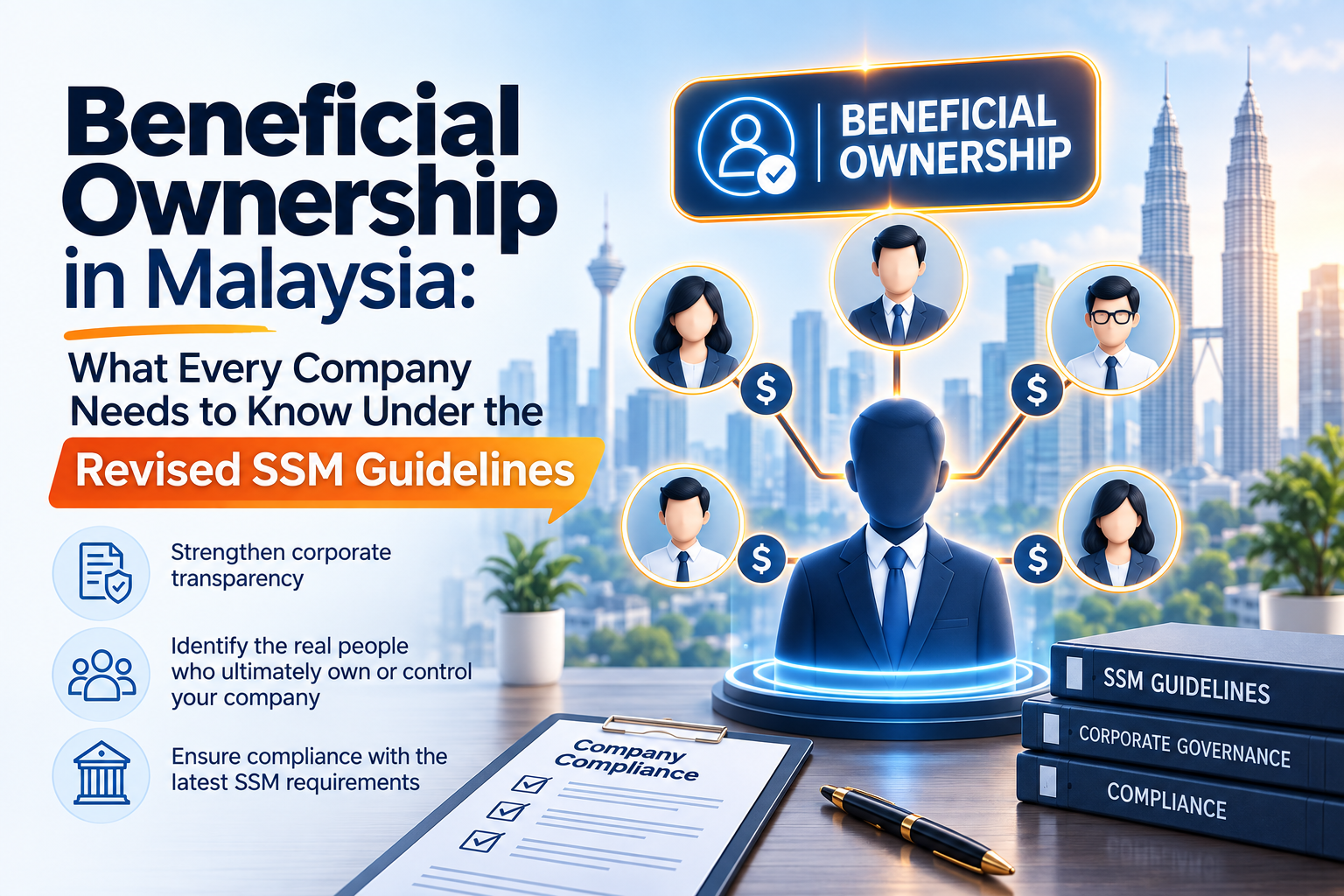

Malaysia has strengthened its Beneficial Ownership (BO) reporting framework to improve corporate transparency and align with international standards against money laundering, terrorism financing, and tax evasion.
With the Companies (Amendment) Act 2024 and the revised Guidelines for the Reporting Framework for Beneficial Ownership of Companies issued by the Companies Commission of Malaysia (SSM), every company should understand its obligations in identifying and maintaining accurate Beneficial Ownership information.
In this article, we explain:
- What is a Beneficial Owner?
- Who must report Beneficial Ownership information?
- The 20% ownership rule and common misconceptions.
- Key updates in the revised SSM Guidelines.
What is a Beneficial Owner?
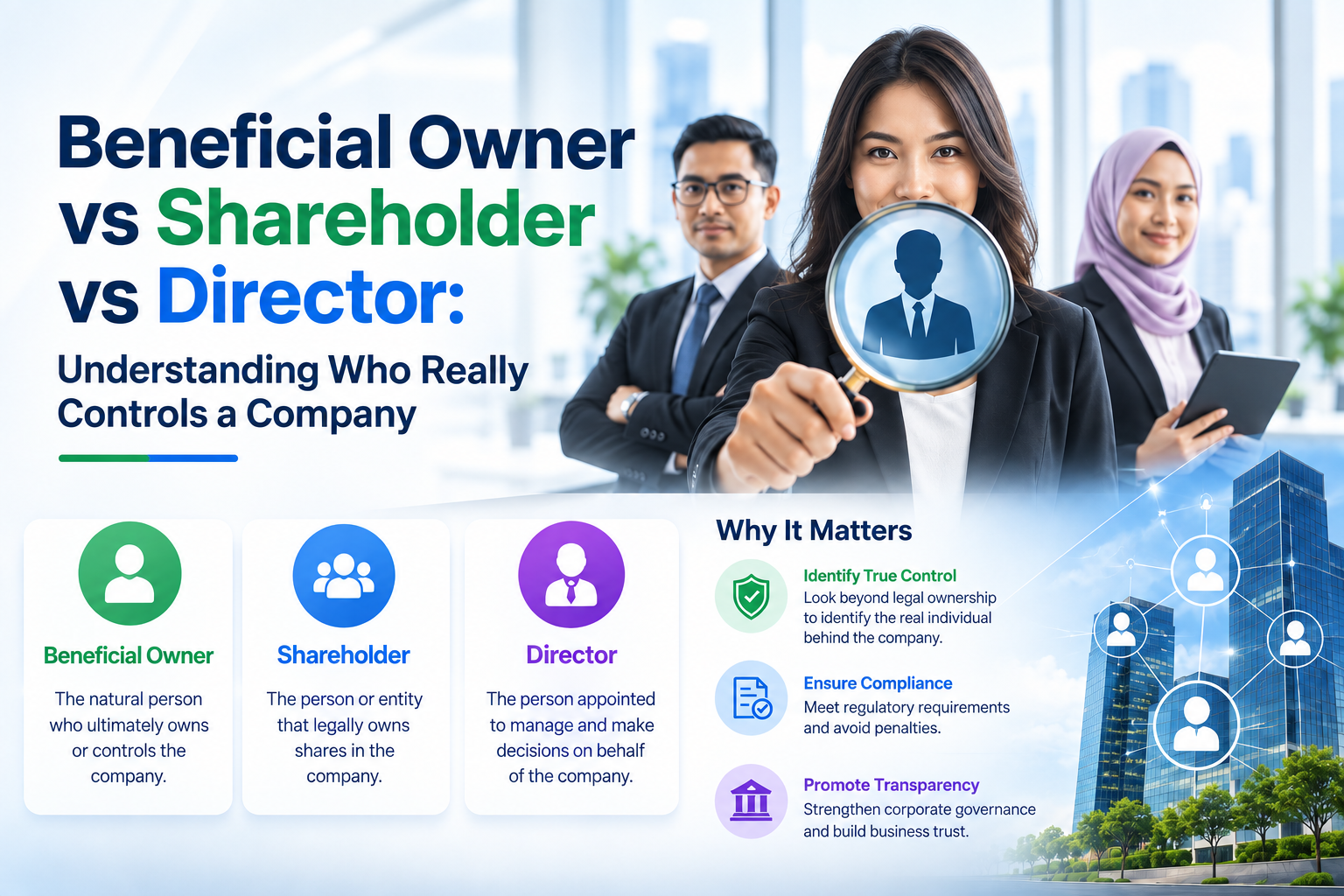
A Beneficial Owner (BO) is a natural person who ultimately owns or controls a company, whether directly or indirectly.
Being a Beneficial Owner is not limited to being listed as a shareholder. A person may qualify as a BO if they exercise significant influence or ultimate effective control over the company through ownership, voting rights, agreements, or other arrangements.
For example:
- A shareholder who owns 30% of a company is generally considered a Beneficial Owner.
- A nominee shareholder holding shares on behalf of another individual is usually not the Beneficial Owner—the person behind the nominee is.
- A company director with no shareholding is not automatically a Beneficial Owner unless they exercise ultimate effective control.
The objective is to identify the individual who truly controls the company.
Who Must Report Beneficial Ownership Information?
Under the Companies Act 2016 and the revised reporting framework, companies incorporated in Malaysia are generally required to:
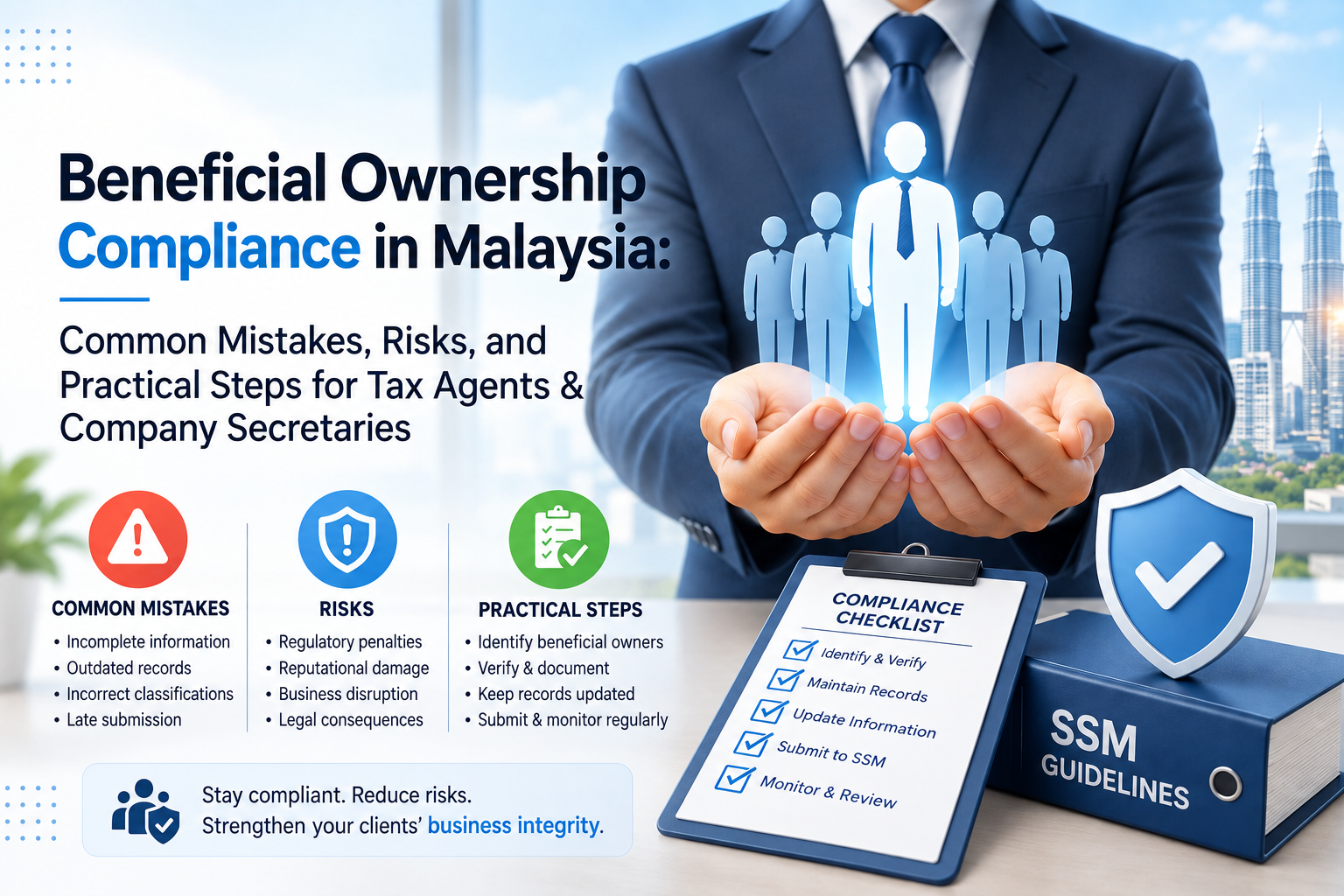
- Identify their Beneficial Owner(s).
- Obtain and verify Beneficial Ownership information.
- Maintain an accurate Register of Beneficial Owners.
- Lodge Beneficial Ownership information with SSM within the prescribed requirements.
- Keep the information updated whenever changes occur.
Companies should also take reasonable steps to determine whether changes in ownership or control affect their Beneficial Ownership records.
Failure to maintain accurate BO information may result in non-compliance with statutory obligations.
Understanding the 20% Rule
One of the most discussed aspects of the revised guideline is the 20% threshold.
Generally, an individual may be considered a Beneficial Owner if they:
- Own at least 20% of the company’s shares.
- Hold at least 20% of the voting rights.
- Have the right to appoint or remove directors.
- Exercise significant influence or ultimate effective control through other means.
However, 20% is only an indicator—not an automatic rule.
Common Misconception #1:
Anyone owning 20% is automatically a Beneficial Owner.
Not necessarily.
The company must also assess whether the individual actually exercises ownership or control.
Common Misconception #2:
Anyone owning less than 20% is never a Beneficial Owner.
Incorrect.
Someone holding only 10% or 15% of the shares may still qualify if they effectively control important business decisions through agreements, voting arrangements, financing, or other mechanisms.
Common Misconception #3:
The registered shareholder is always the Beneficial Owner.
This is another common misunderstanding.
Where shares are held through nominees, trustees, or holding companies, the actual Beneficial Owner may be another individual who ultimately controls those shares.
The revised guideline encourages companies to look beyond legal ownership and determine who truly exercises ultimate effective control.
Key Updates in the Revised 2025 SSM Guidelines
The revised guideline provides clearer explanations and practical examples to assist companies in identifying their Beneficial Owners.
Some notable improvements include:
Clearer interpretation of ultimate effective control
The guideline explains that control extends beyond shareholding percentages and may include contractual rights, voting arrangements, or the ability to influence major business decisions.
Additional practical case studies
More examples are provided for situations involving:
- Nominee shareholders
- Corporate shareholders
- Family-owned businesses
- Trust arrangements
- Indirect ownership structures
- Companies with dispersed shareholdings
These examples help companies apply the rules in real-world scenarios.
Better guidance for compliance
The revised guideline also provides greater clarity on:
- Identifying Beneficial Owners.
- Collecting and verifying information.
- Maintaining internal records.
- Updating Beneficial Ownership information when changes occur.
Why Beneficial Ownership Matters
Beneficial Ownership reporting is more than a compliance exercise.
It promotes greater corporate transparency, strengthens governance, and supports Malaysia’s commitment to international standards in combating financial crime.
For directors, company secretaries, accountants, and business owners, understanding who the true Beneficial Owners are is an important part of maintaining proper corporate records and meeting statutory obligations.
Final Thoughts
The revised SSM Beneficial Ownership Guidelines reinforce an important principle:
The person listed on the share register is not always the person who ultimately owns or controls the company.
Companies should review their ownership structures, identify their Beneficial Owners accurately, and ensure their records remain current.
Understanding the rules today can help businesses avoid compliance issues tomorrow.
Disclaimer: This article is intended for general informational purposes only and should not be regarded as legal or professional advice. Readers should refer to the latest SSM Guidelines and seek professional advice where appropriate.