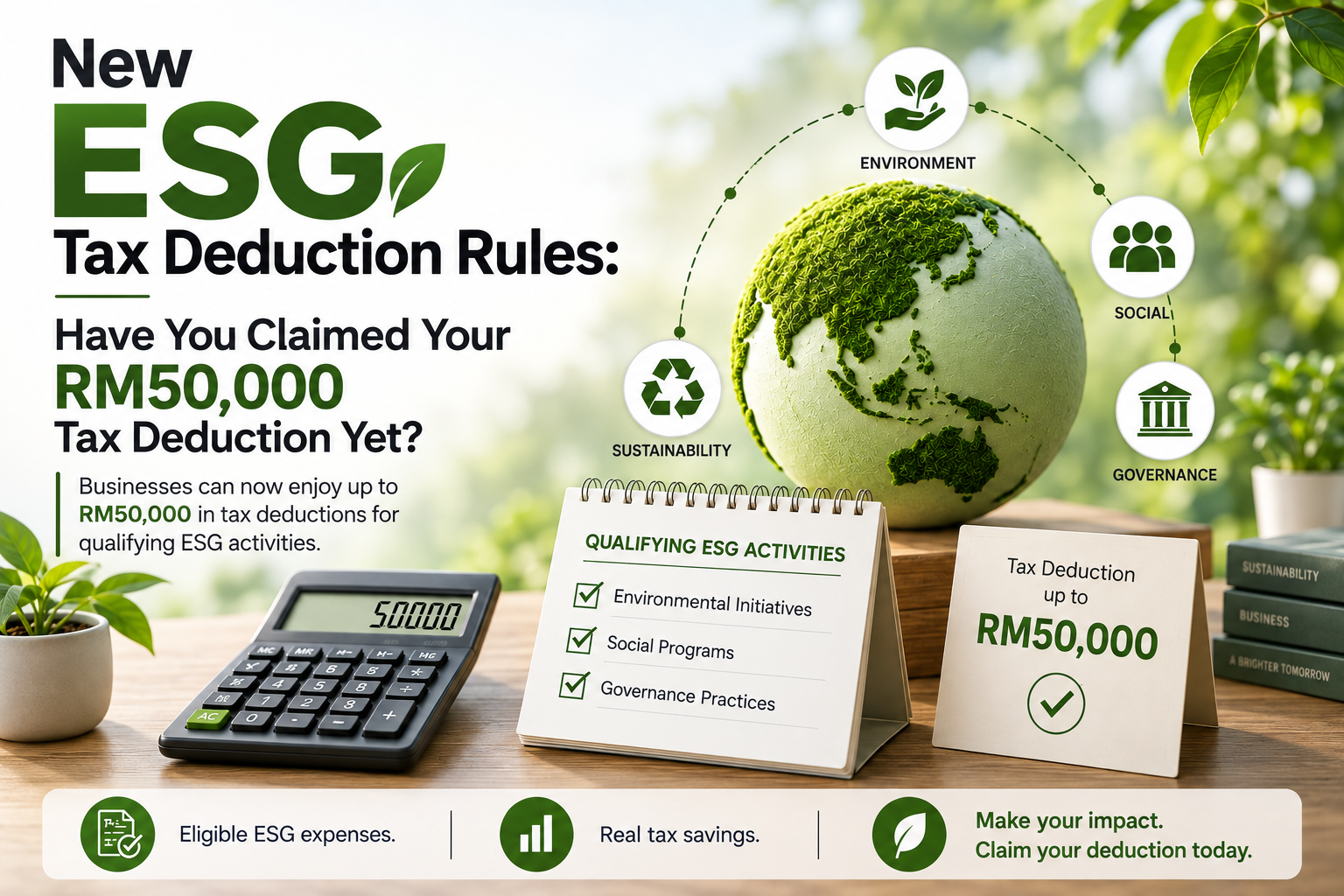

The Government has introduced the Income Tax (Deduction for Expenditure in Relation to Environmental Preservation, Social and Governance) Rules 2025 [P.U.(A) 193/2025], providing businesses with an additional tax deduction for qualifying Environmental, Social and Governance (ESG) expenditure.
Although the Rules were gazetted in 2025, they apply retrospectively from the Year of Assessment (YA) 2024 until YA2027. This means businesses that incurred qualifying ESG-related expenditure during YA2024 may still be eligible to claim the deduction.
What is the ESG Tax Deduction?
Eligible taxpayers may claim a tax deduction of up to RM50,000 per Year of Assessment for qualifying ESG expenditure.
The incentive is designed to encourage businesses to strengthen sustainability practices, improve governance, and support Malaysia’s ESG agenda.
Who Can Benefit?
The Rules cover different categories of taxpayers, including:
- Companies
- Labuan companies
- Listed companies
- Financial institutions regulated by Bank Negara Malaysia
- Micro, Small and Medium Enterprises (MSMEs)
The qualifying expenditure differs depending on the category of taxpayer.
What Expenditure Qualifies?
Examples of qualifying expenditure include:
For Listed Companies & Financial Institutions
- ESG reporting and sustainability reporting
- ESG assurance, verification and certification
- Greenhouse Gas (GHG) emissions measurement
- ESG software and reporting systems
- ESG consultancy services
- ESG-related employee training
For Companies & Labuan Companies
- Tax Corporate Governance Framework (TCGF) reporting
- Independent TCGF compliance review
- Preparation of contemporaneous Transfer Pricing Documentation (TPD)
For MSMEs
- Consultancy fees for developing customised e-Invoice software
- Fees paid to external service providers for e-Invoice implementation
Important Conditions
To qualify for the deduction:
- The expenditure must be incurred between YA2024 and YA2027.
- The expenditure must fall within the categories prescribed under the Rules.
- The deduction is limited to RM50,000 per Year of Assessment.
- Supporting documents such as invoices, agreements, reports and payment records should be retained.
- The same expenditure cannot be claimed twice under different tax incentives or deduction provisions.
Why This Matters
One of the most significant features of these Rules is that they are effective from YA2024, even though they were only gazetted in 2025.
As a result, businesses that have already filed their YA2024 tax return should review whether they incurred qualifying ESG expenditure that was not previously claimed.
Where appropriate, taxpayers may consider amending their YA2024 tax return to include the deduction, subject to the applicable tax rules and amendment timelines.
What Should Businesses Do Now?
✔ Review all ESG-related expenditure incurred from YA2024 onwards.
✔ Identify whether any expenditure qualifies under the ESG Deduction Rules.
✔ Review your YA2024 tax computation.
✔ Consider amending your YA2024 tax return if qualifying expenditure was omitted.
✔ Keep all supporting documentation to substantiate your claim.
Final Thoughts
The ESG Tax Deduction Rules present an excellent opportunity for businesses to reduce their tax liability while investing in sustainability, governance and compliance.
As the Rules apply retrospectively to YA2024, businesses should not assume they have missed the opportunity. A review of past expenditure today could potentially result in valuable tax savings.
If you’re unsure whether your expenditure qualifies, speak to your tax advisor before filing or amending your tax return.