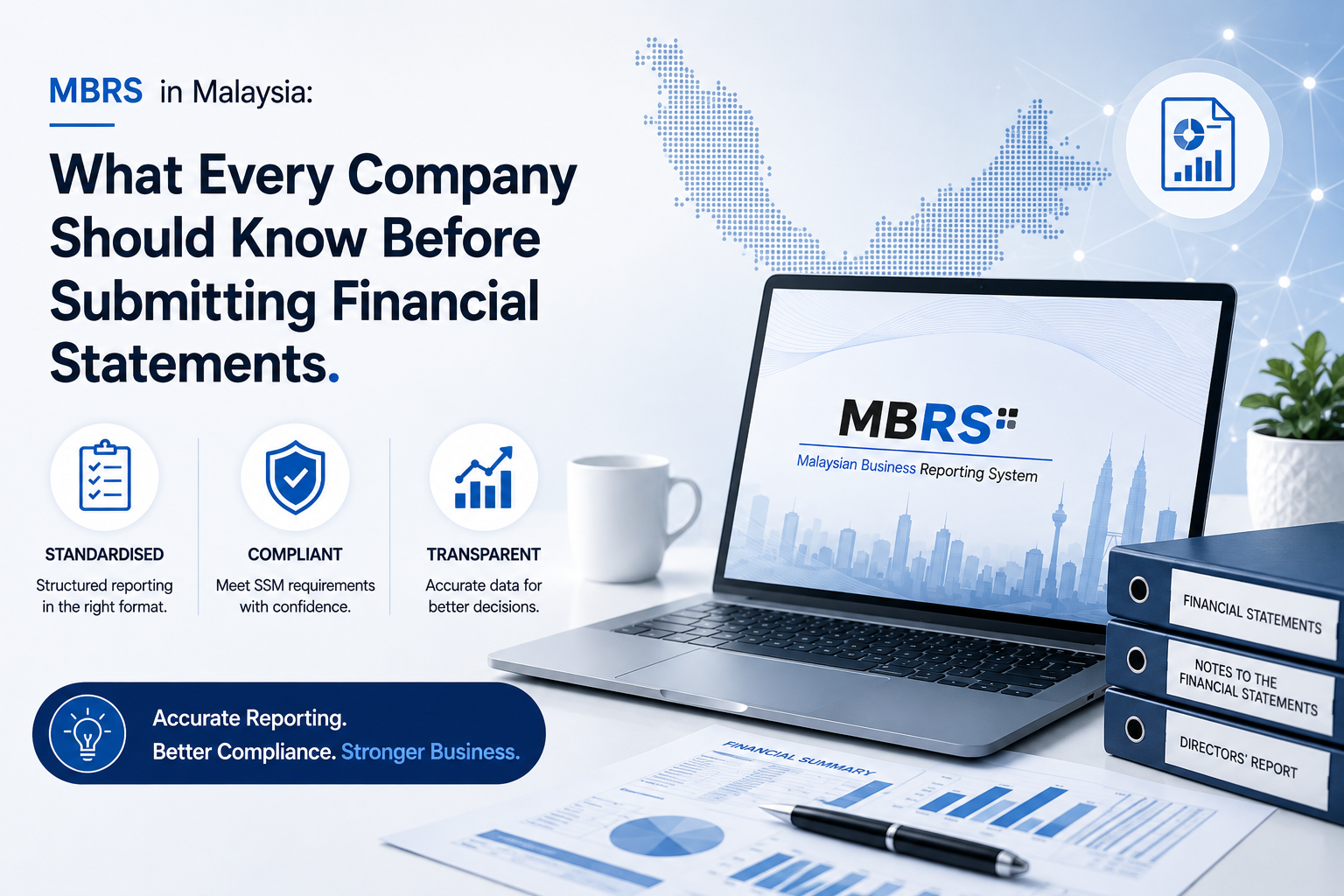

Malaysia’s corporate reporting landscape continues to evolve with digitalisation becoming a key priority. One of the major initiatives introduced by the Companies Commission of Malaysia (SSM) is the Malaysian Business Reporting System (MBRS), an online platform that simplifies the submission of statutory documents while improving data accuracy and transparency.
Whether you’re a company director, accountant, auditor or business owner, understanding the latest MBRS developments can help ensure compliance and avoid unnecessary penalties.
What is MBRS?
The Malaysian Business Reporting System (MBRS) is SSM’s digital platform for submitting:
- Financial Statements (FS)
- Annual Returns (AR)
- Exemption Applications (EA)
The system uses the XBRL (eXtensible Business Reporting Language) format, allowing financial information to be submitted in a structured and standardised manner.
Since its phased implementation in November 2018, MBRS has become an essential compliance requirement for Malaysian companies.
Understanding the MBRS Ecosystem
The MBRS platform consists of three main components:
1. SSM Taxonomy (SSMxT)
Acts as a digital dictionary containing all financial reporting elements based on accounting standards. It also performs validation checks before submission.
2. MBRS Preparation Tool (mTool)
Used to prepare and convert Financial Statements, Annual Returns and Exemption Applications into XBRL format. This helps ensure the submission complies with MBRS requirements.
3. MBRS Portal (mPortal)
The official portal where completed reports are submitted to SSM.
Why Accurate Preparation Matters
Before submission, companies should ensure:
✅ Financial information is entered accurately.
✅ Calculations are verified.
✅ The correct reporting framework (MFRS or MPERS) is selected.
Even minor errors may result in rejected submissions or additional corrections, delaying statutory compliance.
Why SSM Introduced MBRS
MBRS is more than just digital filing.
Its objectives include:
- Improving transparency
- Standardising financial reporting
- Enhancing regulatory monitoring
- Improving data quality through XBRL
- Supporting faster analysis and decision-making
Structured reporting also enables SSM to detect inconsistencies more efficiently.
Good News: Extension of Late Submission Fee Waiver
To encourage compliance during the MBRS transition, SSM has announced an extension of the late lodgement fee exemption.
Companies submitting:
- Financial Statements
- Audited Reports
via MBRS 2.0 on or before 30 November 2025 may enjoy a waiver of late lodgement fees.
Even better, companies are not required to apply separately for this extension.
Penalties for Non-Compliance
Failure to comply with MBRS requirements may result in significant penalties.
For audited companies:
- Fine up to RM50,000
- Further fines for continuing offences
- Directors and company secretaries may also be held personally liable
For audit-exempt companies:
- Fine up to RM20,000
- Continuing offence penalties
- Directors responsible for filing may also be penalised
Timely submission remains the best way to avoid unnecessary costs and legal consequences.
Final Thoughts
As Malaysia continues embracing digital corporate reporting, businesses should ensure they understand the MBRS filing process and stay updated with the latest SSM announcements.
Accurate preparation, timely submission, and compliance with reporting standards will help organisations avoid penalties while supporting greater transparency in corporate reporting.
If your organisation requires assistance with MBRS reporting or wishes to stay updated on the latest regulatory developments, consulting experienced accounting professionals can make the filing process much smoother.