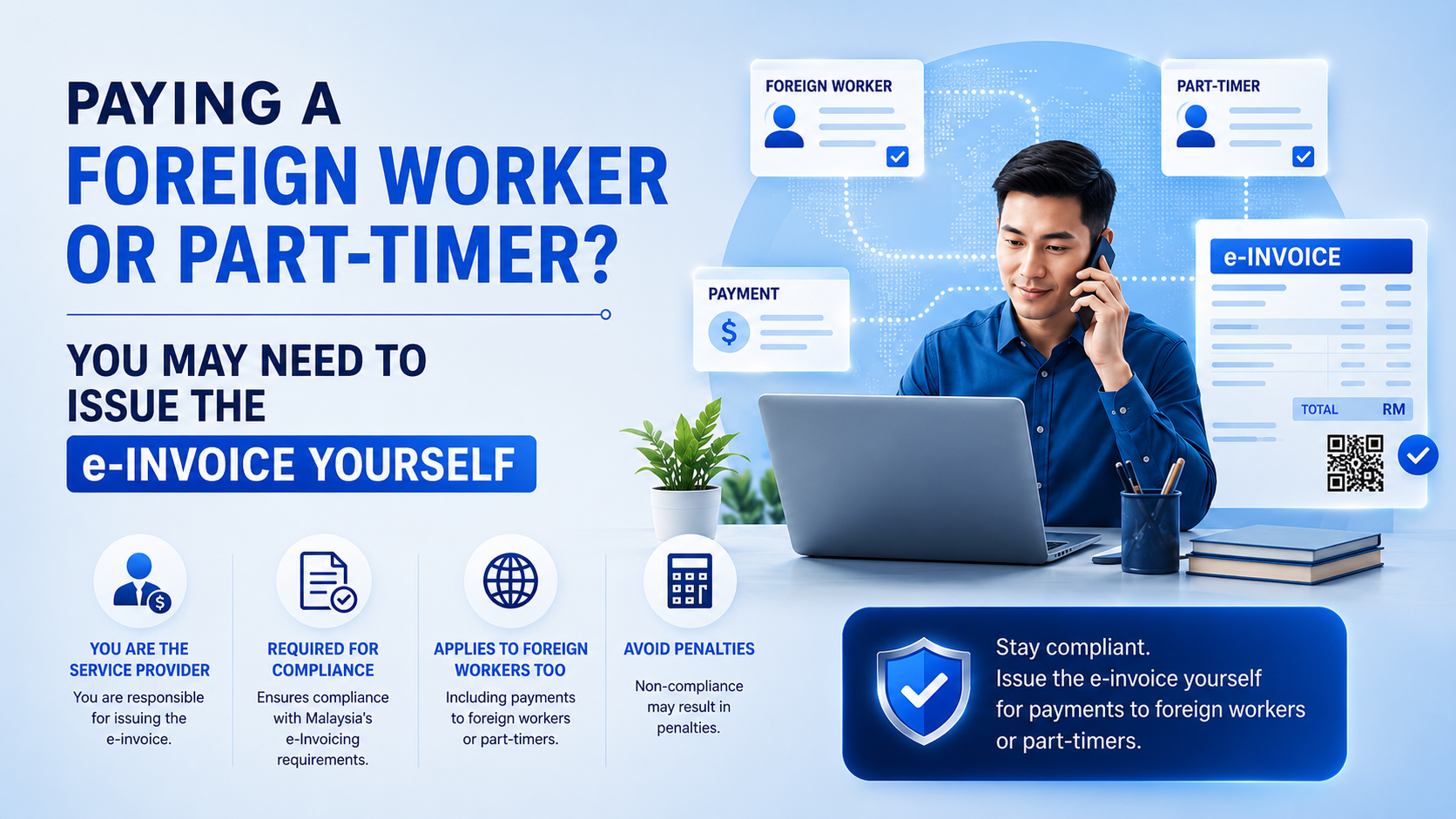

Many businesses assume that every person they pay should issue an e-Invoice. However, this is not always the case.
Under Malaysia’s e-Invoicing framework, the responsibility to issue an e-Invoice depends on the nature of the payment and the relationship between the payer and the recipient—not simply whether the recipient is a foreign worker, part-timer, or freelancer.
Employees Do Not Issue e-Invoices
If you are paying an employee, whether local or foreign, the payment is employment income. Employees do not issue e-Invoices for their salaries, and employers are not required to issue self-billed e-Invoices for normal payroll payments.
For example, if a manufacturing company pays a foreign worker RM2,200 per month under an employment contract, no e-Invoice is required for that salary payment.
The same applies to part-time employees who work under an employment relationship, such as a café assistant working weekends with EPF and SOCSO contributions.
Casual Workers May Be Different
The treatment changes when you engage individuals who are not your employees and are not operating a business.
For example, a warehouse hires several workers for one day to unload containers and pays each worker RM250. The workers do not have business registrations and are not carrying on a business.
In this situation, the business may be required to issue self-billed e-Invoices because the service providers are not able to issue e-Invoices themselves.
Freelancers Running a Business Should Issue Their Own e-Invoices
If you engage a freelancer who operates a registered business, such as a graphic designer or photographer, the responsibility generally falls on the freelancer to issue the e-Invoice (subject to their applicable implementation timeline).
The hiring company should not issue a self-billed e-Invoice where the supplier is responsible for issuing their own e-Invoice.
Final Thoughts
Misclassifying payments can lead to unnecessary compliance issues under the e-Invoicing framework.
Before making payments to foreign workers, part-time workers, freelancers, or casual labourers, businesses should first identify the legal nature of the relationship. This simple step can help ensure the correct party issues the e-Invoice and reduce the risk of non-compliance.