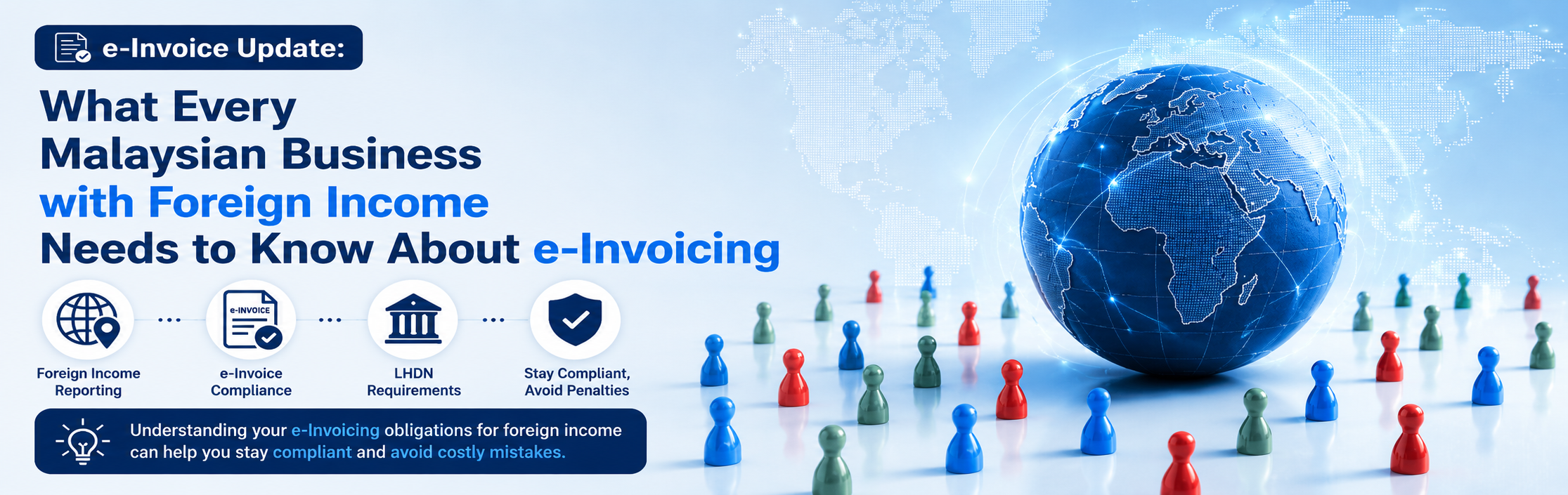

As Malaysian businesses expand beyond local borders, it has become increasingly common to earn income from overseas customers. Whether you provide consultancy services to a Singapore client, sell software subscriptions globally, or receive royalties from abroad, one question often arises:
“If my customer is overseas, do I still need to issue an e-Invoice?”
The answer is yes, in many cases.
On 22 May 2026, the Inland Revenue Board of Malaysia (LHDN) updated its e-Invoice Specific Guideline to provide further clarification on the treatment of foreign-sourced income (FSI) under Malaysia’s e-Invoice framework. The update addresses a common misconception that overseas transactions are automatically excluded from e-Invoicing.
The Customer’s Location Does Not Automatically Exempt You
Many businesses assume that e-Invoicing only applies when dealing with Malaysian customers. However, the updated guideline makes it clear that the customer’s location alone does not determine whether an e-Invoice is required.
If a Malaysian business earns income from an overseas customer as part of its business activities, that transaction may still fall within Malaysia’s e-Invoice requirements.
In other words, being paid from another country does not automatically remove your obligation to issue an e-Invoice.
What Is Considered Foreign Income?
Foreign income generally refers to income received from customers or sources outside Malaysia.
Common examples include:
- Consultancy services provided to overseas companies.
- Software-as-a-Service (SaaS) subscriptions sold to foreign customers.
- Digital marketing or advertising services for overseas businesses.
- Graphic design, engineering, accounting, or professional services performed for foreign clients.
- Licensing fees and royalties received from overseas.
- Online training or educational services delivered internationally.
If the income belongs to your Malaysian business, it should not be assumed to be exempt from e-Invoicing simply because the customer is located overseas.
Do You Need to Send the e-Invoice to Your Overseas Customer?
Not necessarily.
Most overseas customers are unfamiliar with Malaysia’s e-Invoice system and typically only require a commercial invoice for their accounting records.
LHDN recognises this practical situation.
Businesses may continue issuing their usual commercial invoice to the foreign customer while separately generating and submitting the required e-Invoice through Malaysia’s MyInvois system for tax compliance purposes.
The commercial invoice supports the business transaction, while the validated e-Invoice fulfils Malaysia’s reporting requirements.
What About Foreign Currency?
Many international transactions are billed in currencies such as:
- USD
- SGD
- EUR
- GBP
- AUD
This does not prevent the issuance of an e-Invoice.
Businesses should comply with LHDN’s prescribed currency and exchange rate requirements when submitting the e-Invoice, while continuing to invoice their overseas customer in the agreed foreign currency where appropriate.
Practical Examples
Example 1: Consultancy Services
ABC Sdn. Bhd. provides management consultancy services to a company in Singapore and invoices SGD 25,000.
ABC may issue its normal commercial invoice to the Singapore client while also issuing the required e-Invoice for Malaysian tax reporting purposes.
Example 2: Software Subscription
A Malaysian technology company provides monthly SaaS subscriptions to Australian customers.
Although payments are received from Australia, each qualifying transaction may still require an e-Invoice under Malaysia’s e-Invoice framework.
Example 3: Creative Services
A Malaysian design agency produces branding materials for a client in the United Kingdom.
The overseas location of the customer does not automatically remove the company’s e-Invoice obligation.
Common Misconceptions
❌ “The customer is overseas, so e-Invoice is not required.”
Not necessarily. The location of your customer alone does not determine your e-Invoice obligation.
❌ “Foreign currency invoices cannot be submitted.”
Incorrect. LHDN allows foreign currency transactions, subject to its prescribed reporting requirements.
❌ “My overseas customer must receive the validated e-Invoice.”
Not necessarily. In many cases, the commercial invoice is issued to the customer, while the e-Invoice is generated separately for Malaysian tax compliance.
A Separate Issue from Taxability
It is important to distinguish between e-Invoice reporting and income tax treatment.
The 22 May 2026 update focuses on whether a qualifying transaction should be reported through Malaysia’s e-Invoice system. It does not determine whether the foreign-sourced income is taxable in Malaysia.
The taxation of foreign-sourced income is governed by separate provisions under Malaysia’s income tax legislation and should be assessed independently.
Final Thoughts
As Malaysian businesses continue to serve customers worldwide, compliance with Malaysia’s e-Invoice framework extends beyond domestic transactions.
If your business earns income from overseas, do not assume that no e-Invoice is required simply because your customer is located outside Malaysia. Review the nature of the transaction, understand your reporting obligations, and ensure compliance with LHDN’s latest guidance.
When in doubt, seek professional advice to avoid unnecessary compliance risks and ensure your business remains aligned with Malaysia’s evolving e-Invoice requirements.