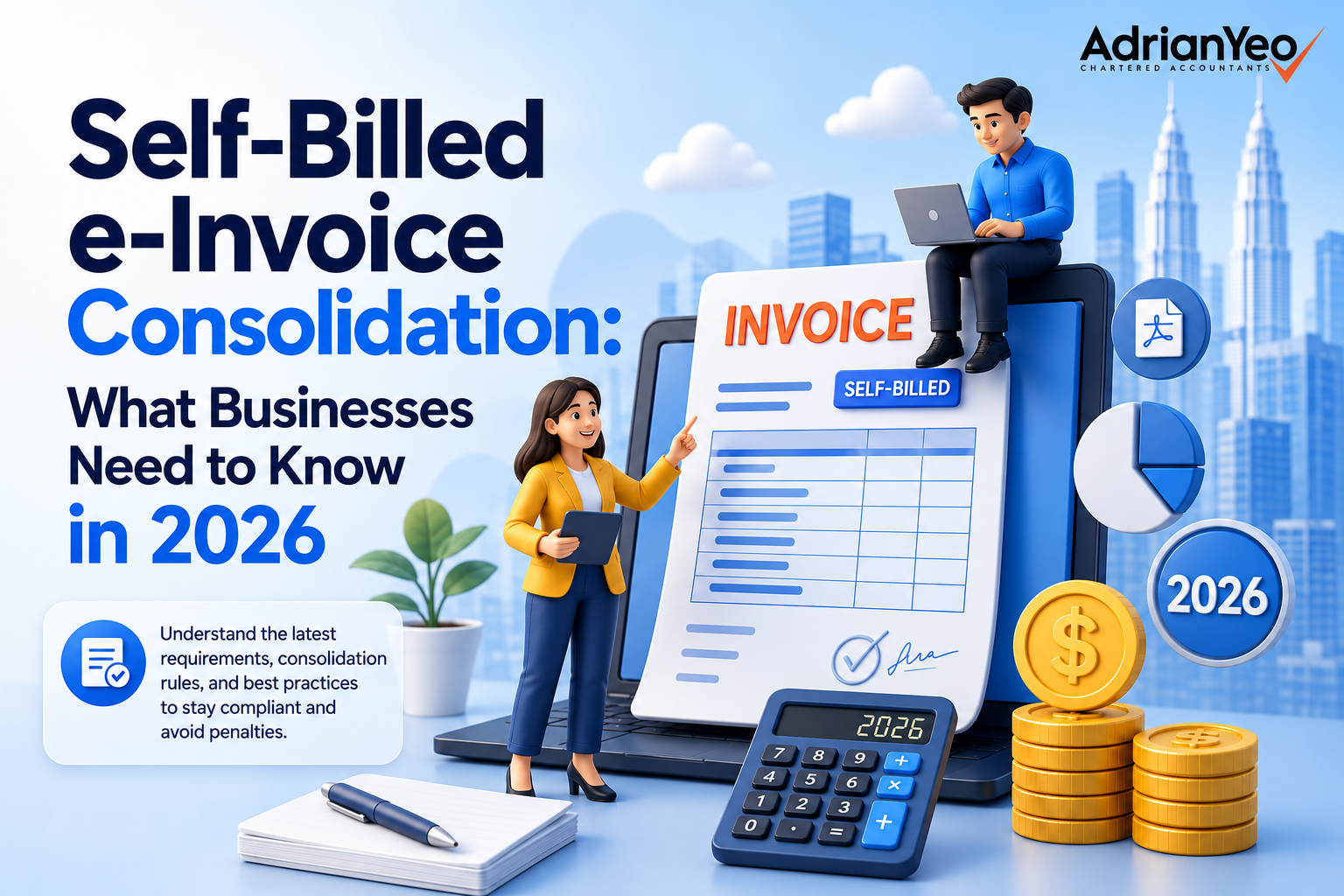

Can a business consolidate its self-billed e-Invoices instead of issuing one for every transaction?
The answer is yes — but businesses need to understand the current rules and, importantly, the interim relaxation period.
Under Malaysia’s e-Invoice framework, there are certain situations where the buyer, rather than the supplier, is required to issue a self-billed e-Invoice.
This includes situations such as payments to agents, dealers or distributors, transactions with foreign suppliers, certain transactions with individuals who are not conducting a business, interest payments and other prescribed circumstances.
What is a self-billed e-Invoice?
Normally, the supplier issues an e-Invoice to the buyer.
For a self-billed e-Invoice, the buyer takes on the role of the supplier and issues the e-Invoice on behalf of the other party.
Once the self-billed e-Invoice has been validated by HASiL, it can be used by the buyer as supporting documentation for the expense. The buyer is also required to share the validated self-billed e-Invoice with the supplier, subject to the concession currently provided by HASiL.
When is self-billed e-Invoice required?
Under the current Specific Guideline, self-billed e-Invoices may be required for, among others:
- Payments to agents, dealers and distributors;
- Goods purchased or services obtained from foreign suppliers;
- Certain profit distributions, such as dividends;
- Certain e-commerce transactions;
- Payments to betting and gaming winners;
- Transactions with individuals who are not conducting a business, where applicable;
- Certain interest payments;
- Certain insurance claims, compensation or benefit payments; and
- Certain payments relating to capital reduction, share or unit redemption, share buyback, return of capital or liquidation proceeds.
The exact treatment depends on the nature of the transaction, so businesses should not assume that every payment to an individual or third party automatically requires a self-billed e-Invoice.
So, what is a consolidated self-billed e-Invoice?
A consolidated self-billed e-Invoice allows multiple qualifying self-billed transactions to be aggregated into a consolidated submission instead of issuing a separate self-billed e-Invoice for every transaction.
This can significantly reduce the administrative burden for businesses that have a large number of similar self-billed transactions.
However, consolidation does not mean that the underlying transactions can simply be ignored.
Businesses should still maintain proper records supporting each individual transaction.
The important 2026 point: Interim relaxation
This is where businesses need to pay particular attention.
HASiL’s current guidance provides an interim relaxation period for taxpayers in the relevant implementation phases.
For taxpayers with annual turnover or revenue of up to RM5 million, the interim relaxation extends until 31 December 2027, depending on the applicable implementation date.
During the interim relaxation period, taxpayers are allowed to:
- Issue consolidated e-Invoices for all activities and transactions;
- Issue consolidated self-billed e-Invoices for all self-billed circumstances covered under Section 8.3;
- Enter information of their choice in the “Description of Product or Service” field for consolidated e-Invoices and consolidated self-billed e-Invoices; and
- Not issue an individual e-Invoice or individual self-billed e-Invoice even when the buyer or supplier requests one, provided the taxpayer complies with the applicable consolidation requirements during the relaxation period.
This means that, during the applicable interim relaxation period, businesses have considerably more flexibility in managing consolidated self-billed e-Invoices.
But don’t confuse “consolidated” with “no records required”
This is an important practical point.
A consolidated self-billed e-Invoice is still an e-Invoice submission.
Businesses should maintain sufficient records to support:
- Who was paid;
- What the payment was for;
- The transaction date;
- The amount paid;
- The relevant supplier or recipient information;
- Supporting invoices, receipts, agreements or other documents; and
- The reconciliation between the underlying transactions and the consolidated self-billed e-Invoice.
The current guidance also provides specific information requirements for self-billed e-Invoices. For example, the supplier’s name, TIN, identification or registration details, address, contact number and other relevant information may be required depending on the circumstances.
What happens after the relaxation period?
Businesses should not build their processes around the assumption that the current relaxation will continue indefinitely.
The interim relaxation is currently stated to run until 31 December 2027 for the relevant taxpayers.
Therefore, businesses should use this period to:
Review → Identify → Consolidate → Reconcile → Prepare
Review the types of payments made by the business.
Identify which transactions fall under the self-billed e-Invoice requirements.
Determine which transactions can be consolidated under the applicable rules.
Reconcile the consolidated e-Invoice against the underlying payment records.
And most importantly, prepare systems and procedures for the requirements that will apply after the relaxation period.
A practical example
Imagine a company regularly pays commissions to 50 independent agents every month.
The company is required to issue self-billed e-Invoices for qualifying payments to agents.
Instead of processing 50 separate self-billed e-Invoices during the applicable interim relaxation period, the company may use the permitted consolidated self-billed e-Invoice approach.
However, the company should still retain its agent payment schedules, commission calculations and other supporting records so that the total amount in the consolidated submission can be properly reconciled.
What should businesses do now?
If your business makes payments to agents, dealers, distributors, foreign suppliers, individuals or other parties covered by the self-billed e-Invoice rules, it is a good time to review your current process.
Ask:
“Who are we paying?”
“Why are we paying them?”
“Are we required to issue a self-billed e-Invoice?”
“Can the transactions be consolidated?”
“What supporting records do we need to retain?”
“Can our accounting system reconcile the consolidated submission back to individual transactions?”
Getting the process right now can help prevent a much bigger compliance problem later.
Key takeaway
Self-billed e-Invoice consolidation is an important administrative relief — but it is not a shortcut to proper record-keeping.
Businesses should understand when self-billing applies, make use of the current consolidation flexibility where appropriate, and ensure that every consolidated amount can still be traced back to the underlying transactions.
The best approach is to use the relaxation period to build a proper process now, rather than waiting until the relaxation period ends.
This article is prepared for general information purposes based on the HASiL e-Invoice Specific Guideline and related materials available as at August 2026. Businesses should refer to the latest HASiL guidance for their specific circumstances.